About Nigeria
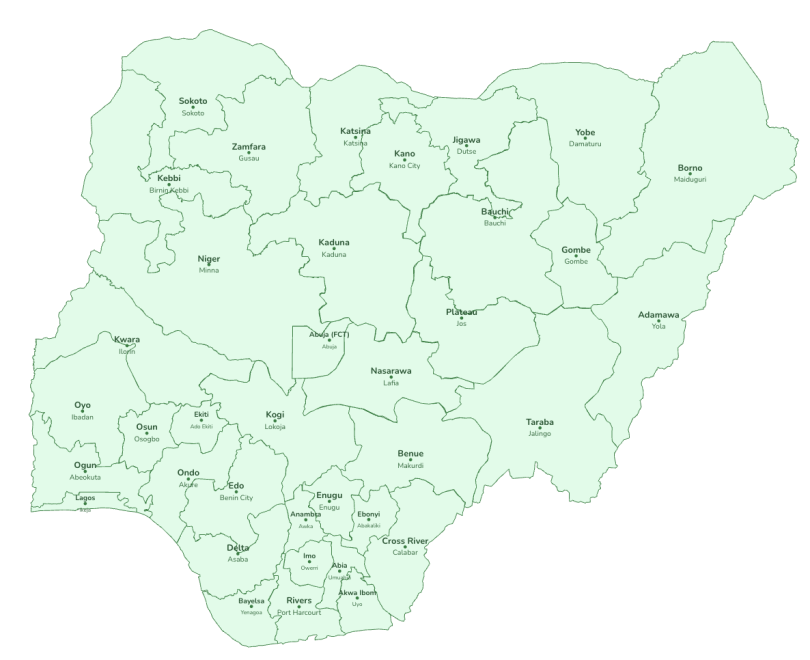
Nigeria is the most populous nation in Africa and the largest economy on the continent — a federation of 36 states and the Federal Capital Territory of Abuja, home to more than 220 million people and over 250 distinct ethnic groups bound together by a shared national identity.
An overview
The Federal Republic of Nigeria sits in West Africa along the Gulf of Guinea, bordered by Niger to the north, Chad and Cameroon to the east, Benin to the west, and the Atlantic Ocean to the south. Its land area of roughly 923,768 km² stretches from coastal mangroves and rainforests in the south through a vast central savannah to the semi-arid Sahel of the far north — a geography that has shaped the country’s farming, trade, and cultural diversity for centuries.
Modern Nigeria was formed in 1914 through the amalgamation of the Northern and Southern Protectorates by the British colonial administration, and gained independence on 1 October 1960. It became a republic in 1963 and, after decades of civilian and military rule, returned to enduring democratic governance in 1999. Today Nigeria operates a presidential federal system with three tiers of government — federal, state, and local — each anchored by an executive, a legislature, and an independent judiciary.
English is the official language of government, education, and commerce, while Hausa, Yoruba, and Igbo are the most widely spoken indigenous languages alongside hundreds of others. The currency is the Nigerian naira (₦), the country uses West Africa Time (UTC+1) year-round, and its international dialling code is +234.
Quick facts
Geography & geo-political zones
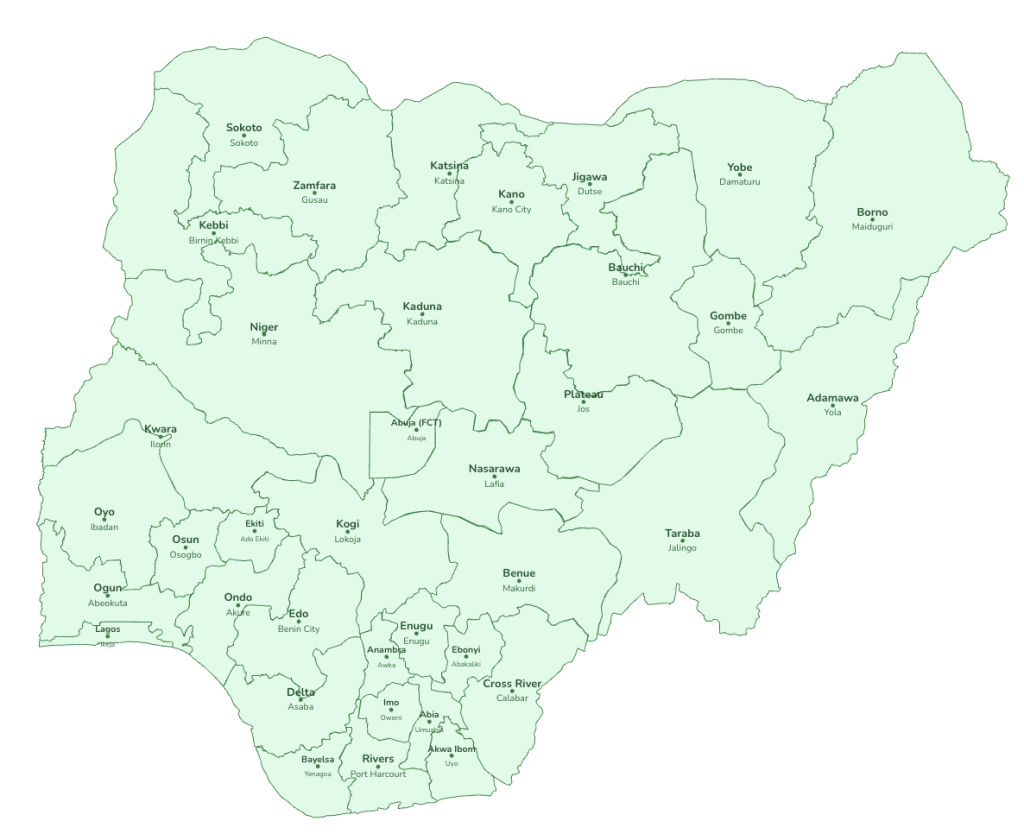
For administrative and political balance, Nigeria’s 36 states and the FCT are grouped into six geo-political zones. These zones — though informal — play an important role in elections, federal appointments, and the country’s social fabric.
- North West — Jigawa, Kaduna, Kano, Katsina, Kebbi, Sokoto, Zamfara
- North East — Adamawa, Bauchi, Borno, Gombe, Taraba, Yobe
- North Central — Benue, Kogi, Kwara, Nasarawa, Niger, Plateau, FCT
- South West — Ekiti, Lagos, Ogun, Ondo, Osun, Oyo
- South East — Abia, Anambra, Ebonyi, Enugu, Imo
- South South — Akwa Ibom, Bayelsa, Cross River, Delta, Edo, Rivers
People & culture
Nigeria’s population is one of the youngest in the world, with a median age of around 18. Three large ethnic groups — the Hausa-Fulani of the north, the Yoruba of the south-west, and the Igbo of the south-east — sit alongside hundreds of smaller nations including the Ijaw, Kanuri, Tiv, Ibibio, Efik, Nupe, Edo, and many more. Islam and Christianity are the two largest faiths, practised alongside enduring indigenous traditions.
The country’s cultural output reaches the world through Nollywood, the second-largest film industry on Earth by annual output, and through Afrobeats — a genre, pioneered locally, that has become a defining sound of contemporary global pop. Festivals like the Eyo of Lagos, Argungu fishing festival of Kebbi, Durbar of the northern emirates, and the Calabar Carnival showcase a heritage that is at once deeply rooted and continuously reinvented.
Economy
Nigeria has Africa’s largest economy by GDP. Crude oil and natural gas from the Niger Delta have long anchored government revenue and exports, but agriculture — cassava, yams, sorghum, cocoa, and a growing rice sector — remains the country’s largest source of employment. Lagos has emerged as a continental hub for fintech and start-ups, with companies such as Flutterwave, Paystack, and Andela helping to put Nigeria at the centre of African technology.